Maintaining civic norms far outpaced inflation and immigration in November election.
RICHMOND, Va. (Feb. 10, 2026) — Virginians continue to express deep concern about the state of democracy, according to findings from the latest Commonwealth Poll released today by the L. Douglas Wilder School of Government and Public Affairs at Virginia Commonwealth University. The poll was conducted Jan. 9-22, 2026.
View the full results of the poll
Results show that concerns about democracy and civic norms played a central role in voter behavior and policy priorities in the November gubernatorial election. When asked about their motivation for voting, a plurality of registered voters (41%) said maintaining democracy and civility was their top reason for turning out. Similarly, nearly one-third (32%) of respondents said threats to democracy should be the top issue facing legislators during the current General Assembly session.
“These findings send a clear and sobering message. Democracy is not self-executing.,” said L. Douglas Wilder, the 66th governor of Virginia and distinguished professor at the Wilder School. “When 41 percent of Virginians say that maintaining democracy and civility was their reason for voting, and 32 percent say threats to democracy should be the top issue facing legislators, that is neither abstract nor partisan. It is a directive. It calls for open discussion and responsible action by the representatives of the people. And if that discussion and action are absent, we must ask why.
“Diversity, equity and inclusion are not relics of the past. They are reminders of the need for eternal vigilance to protect democratic norms, civic trust and the integrity of our public institutions.”
Voting in 2025 statewide elections
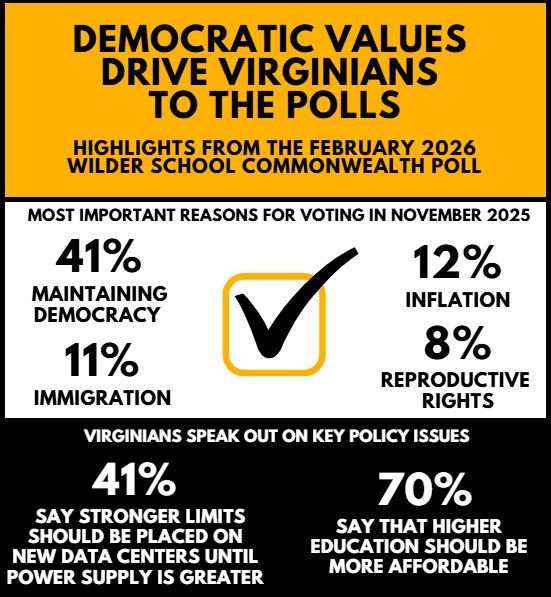
Nearly 9 in 10 Virginians (86%) in the new poll reported voting in the Nov. 5 statewide elections. Maintaining democracy and civility was cited as the most important reason for voting (41%), followed by inflation (12%) and immigration (11%).
Maintaining democracy and civility ranked as the top motivator across party lines, though at varying levels: 58% of Democrats, 22% of Republicans and 32% of independents cited it as their primary reason for voting. This marks a notable shift from the Commonwealth Poll conducted a year ago in winter 2025, when a majority of voters identified the economy and cost of living as their primary concern.
Priorities for the General Assembly
For the current legislative session, 3 in 10 registered voters in Virginia said the General Assembly should focus on threats to democracy (30%). Inflation (24%) and education (11%) ranked as the second- and third-highest priorities.
Partisan differences were pronounced. Nearly half of Democrats (49%) identified threats to democracy as their top priority, while inflation was the leading concern among Republicans (32%) and independents (25%).
Data centers, energy demand and electricity reliability
Data centers continue to expand rapidly across Virginia, increasing demand on the state’s electric grid. PJM, the regional electric grid operator, has warned that rising data center demand could increase the risk of blackouts unless new policies are adopted.
When asked how Virginia should respond, the most common view among registered voters (46%) was to allow data center growth while requiring companies to add new power generation or reduce electricity use during periods of high demand. A similar share of respondents (41%) said Virginia should place stronger limits on new data centers until sufficient power supply is available.
Compared with last year’s Commonwealth Poll, when 46% supported allowing more data centers and 38% were opposed, the new results suggest continued openness to data center development paired with increased expectations for accountability around energy use.
Half of Democrats (50%) favor stronger limits on new data centers, while Republicans (46%) and independents (57%) more often support continued growth with additional power-generation requirements or demand reductions.
Support for the legal retail sale of cannabis
As Virginia lawmakers consider proposals to establish a legal, regulated adult-use cannabis retail market, a majority of registered voters (59%) said they support allowing retail cannabis sales under a framework that includes licensing for small businesses, government oversight and consumer protection.
Support was strongest among Democrats (73%) and independents (62%). Republicans were more divided, with 42% in favor and 48% opposed.
College affordability
Currently, the average total cost of college at a four-year institution in Virginia is $28,640, or a total of $114,560 for a four-year undergraduate degree. Seven in 10 registered voters (70%) said students should not have to pay this amount to attend an in-state college or university.
Opposition to the cost was strongest among Democrats (85%), compared with 50% of Republicans and 71% of independents. Among those who said students should pay the average cost, Republicans (42%) were more likely to support the expense than Democrats (12%) or independents (19%).
When asked which policies would most effectively reduce college costs, half of respondents (50%) support requiring higher education institutions to cut costs, while 46% favored making community college free for all Virginia students. Democrats were more likely to support free community college (62%), while cost-cutting measures at colleges and universities were preferred by Republicans (53%) and independents (46%).
Views on the value of a four-year degree remain mixed. A majority of Virginians (52%) said a four-year college degree provides a good return on investment only for certain fields or majors, a view that is consistent across political affiliations and largely unchanged from last year (54%).
###
About the L. Douglas Wilder School of Government and Public Affairs at VCU
Ranked in the top 15% of graduate schools of public affairs in the nation by U.S. News & World Report — No. 39 among Graduate Schools of Public Affairs, No. 6 in Homeland Security, and No. 33 in Public Management and Leadership — the L. Douglas Wilder School of Government and Public Affairs at Virginia Commonwealth University advances excellence in governance and promotes evidence-based public policy across Virginia and beyond.
The school offers a range of graduate, post-baccalaureate, and doctoral programs in key policy areas, including criminal justice; homeland security and emergency preparedness; public administration; public policy and administration; and urban and regional planning.
Additionally, the Wilder School is home to robust Centers and Institutes for Public Policy, which provide applied research and services in state and local government, social equity, and leadership to clients in government, nonprofit organizations, businesses, and the general public. Learn more at wilder.vcu.edu.
About VCU and VCU Health
Virginia Commonwealth University is a major, urban public research university with national and international rankings in sponsored research. Located in downtown Richmond, VCU enrolls more than 28,000 students in more than 200 degree and certificate programs in the arts, sciences and humanities across VCU’s 12 schools and three colleges. The VCU Health brand represents the VCU health sciences academic programs, the VCU Massey Comprehensive Cancer Center and the VCU Health System, which comprises VCU Medical Center (the only academic medical center in the region), Community Memorial Hospital, Tappahannock Hospital, Children’s Hospital of Richmond at VCU and MCV Physicians. The clinical enterprise includes a collaboration with Sheltering Arms Institute for physical rehabilitation services. For more, please visit vcu.edu and vcuhealth.org.
About the VCU Wilder School Commonwealth Poll
For nearly three decades, the VCU Wilder School Commonwealth Poll within the Centers and Institutes for Public Policy has been an important bellwether for policymakers in Virginia and beyond on a range of topics, including voting intentions, economic and workforce development, education, housing, public health, public safety and racial equity. The Commonwealth Poll is a featured 2020 Presidential Election Poll by CNN, approved based on a rigorous review of methodologies and assumptions that ensure that CNN-cited polling entities are employing the gold standard in public opinion research.
Methodology
The Winter 2026 Commonwealth Poll, sponsored by Virginia Commonwealth University, obtained telephone interviews with a representative sample of 806 adults, ages 18 or older, living in Virginia. Telephone interviews were conducted by landline (80) and cell phone (726, including 532 without a landline telephone). The survey was conducted by Responsive Management. Interviews were conducted in English from January 9, 2026, to January 22, 2026.
In telephone survey research, design weights are often employed to reduce bias, correcting for differences in the probability of selection due to non-response and non-coverage. The sample was weighted to match Virginia’s adult population, which was the primary sampling unit. The geographic and demographic weighting parameters were obtained from the U.S. Census Bureau’s most recent American Community Survey (ACS) data. Two sampling frames were employed: one frame representing those with a listed landline and a second frame consisting of random digit dial (RDD) cellular numbers. A two-stage weighting procedure was used to weight this dual-frame sample. Weighting was accomplished using the Anesrake package, which implements the American National Election Study (ANES) weighting algorithm. The total sample design effect for this survey is 1.62 and the margin of error for the entire sample is ±4.40 percentage points.
The combination sample consisted of a listed landline sample and a cell random digit dial (RDD) sample to represent all adults in Virginia who have access to a listed landline or cell telephone. Both samples were provided in their proper proportions according to state telephone type usage by Marketing Systems Group, a leader in providing research-based statistical samples. Non-productive numbers were identified and removed from the sample via CELL-WINS, a non-intrusive real-time screening process that identifies active and inactive numbers.
As many as seven attempts were made to contact every landline telephone number, and as many as five attempts were made to contact each cell phone number. Calls were made at different times of day and different days of the week to maximize the chance of contacting potential respondents. Each telephone number received at least one daytime call when necessary.
In addition to the five attempted phone calls for each cell number, cell numbers that were not reachable in five attempts were sent a message via Short Message Service (SMS) with one final request to participate in the study. The SMS message contained a link that would lead the respondent to the internet survey. Of the 726 surveys completed with cell sample, 104 were completed using the link provided in the SMS message. For the landline sample, the computer questionnaire instructed interviewers to ask to speak with the youngest adult currently at home. Selecting respondents in this manner has resulted in data that closely mirrors the population’s age when combined with cellular sampling. For the cellular sample type, interviews were conducted with an adult who answered the telephone. Response rates were computed according to American Association for Public Opinion Research standards. Thus, the response rate for the landline sample is 5.3 percent. The response rate for the cellular sample is 9.1 percent.
The American Association for Public Opinion Research. 2016. Standard Definitions: Final Dispositions of Case Codes and Outcome Rates for Surveys. 9th edition. AAPOR.

.jpg)