In most classrooms, intelligence analysis is something students read about. At the L. Douglas Wilder School of Government and Public Affairs at Virginia Commonwealth University, it is something they do. In an interdisciplinary independent study within the Homeland Security and Emergency Preparedness program, students confronted real-world threats, analyzed open-source intelligence and produced briefing materials for federal decision-makers.
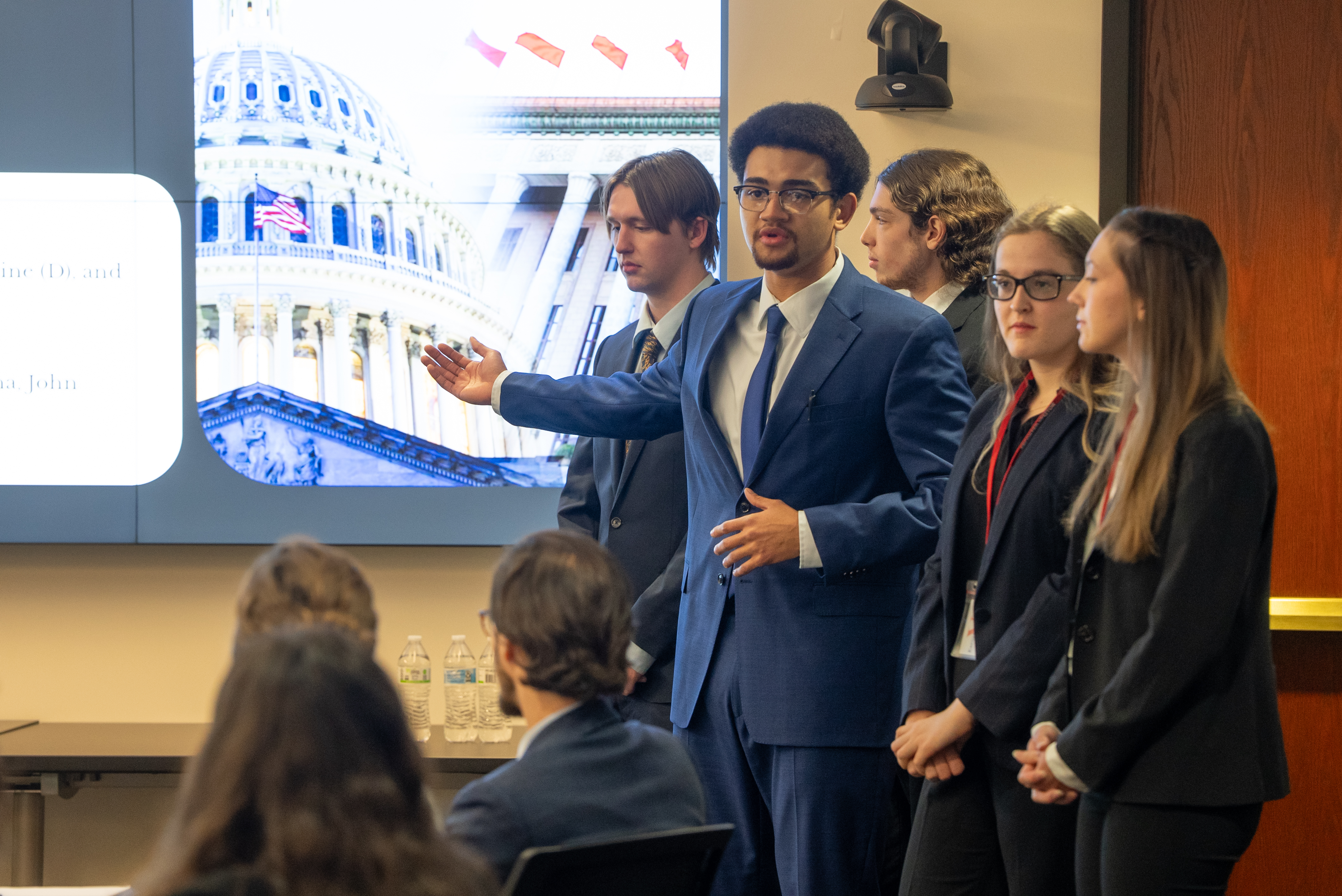
During the fall semester, a team of students led by faculty members Larry Prokop and Maureen Moslow-Benway, delivered an extensive briefing to agents at the FBI’s Richmond field office on foreign threat pathways affecting the commonwealth.
The semester-long project strengthened students’ research, presentation and communication skills while demonstrating how applied knowledge builds confidence and professional credibility.
A thorough presentation
Moslow-Benway and Prokop recruited an interdisciplinary team of nine undergraduate students to offer an in-depth threat analysis to intelligence analysts and federal agents at Richmond’s FBI headquarters in November 2025.
“We had math, political science, engineering, of course homeland security and emergency preparedness (HSEP), criminal justice, and English majors,” recalls Moslow-Benway, reflecting the value of drawing from a wide range of student disciplines.
Students gathered open-source information related to foreign threat activity affecting Virginia, classifying findings across a variety of sectors, including government, business and education. Their research examined how foreign adversaries seek to influence and exploit vulnerabilities within these sectors.
The group also considered how adversaries fundraise and how resources are allocated. Following the presentation, agents expressed strong appreciation for the students’ work and invited them to return.
“I would put them up against any of the intelligence analysts I worked with in the bureau because of the research and the critical thinking they put into this,” said former FBI analyst and faculty member Prokop.
“I can't even tell you how proud I was,” said Moslow-Benway. “They nailed it. They were so good. Every single one of them was on their A-game.”
Building experiences that lead to opportunities
A well-rounded résumé may look strong on paper, but hands-on experience addressing complex security challenges can make a meaningful difference — particularly in careers in homeland security, emergency preparedness, criminal justice and national security.
“The students got to brief out every senior person in the Richmond field office, from the special agent in charge to every agent who leads the criminal, white-collar crime, and counterintelligence divisions,” explained Moslow-Benway. “The entire leadership team came to hear the students present their findings, which is pretty impactful.”
Experiential learning also allows students to explore the breadth of career paths within their field. Exposure to counterterrorism, counterintelligence and forensic accounting roles helps students better understand where their interests and strengths align.
“It's so important that we expose them to all of these different areas they can work in,” said Prokop. “There are jobs for almost anything you want to do in the federal government, so it's important that they understand different areas unconsidered.”
Richmond’s concentration of federal law enforcement and intelligence agencies further expands opportunity for students. For many, obtaining a high-level security clearance can open significant professional doors.
“Many interns who worked with me at the FBI Richmond office were offered a job at the end and were given top secret clearance,” recalls Prokop. “It's not like they're emptying the trash and escorting people. They were working with real-world threats alongside me.”
“We're excited because this is an opportunity of a lifetime for these students to get their faces and names in front of people that they may want to work with in the future,” said Prokop.
A bright future for HSEP
The skills students gain — critical thinking, research, writing, networking and communication — position them to help protect Virginia, the nation and its citizens.
To meet that need, Prokop and Moslow-Benway are working to expand experiential learning opportunities within the HSEP program by increasing student engagement and strengthening partnerships with public-sector agencies. Moslow-Benway has already recruited a new group of students for a spring presentation and hopes to continue expanding participation in the future.
“We want students to be a part of something bigger than themselves,” said Moslow-Benway. “Russia, China, Iran and North Korea all pose cyber threats, and with the advent of AI, there’s uncertainty on how that’s going to change, so there is a huge need for HSEP professionals ahead.”